
 (312) 224-8620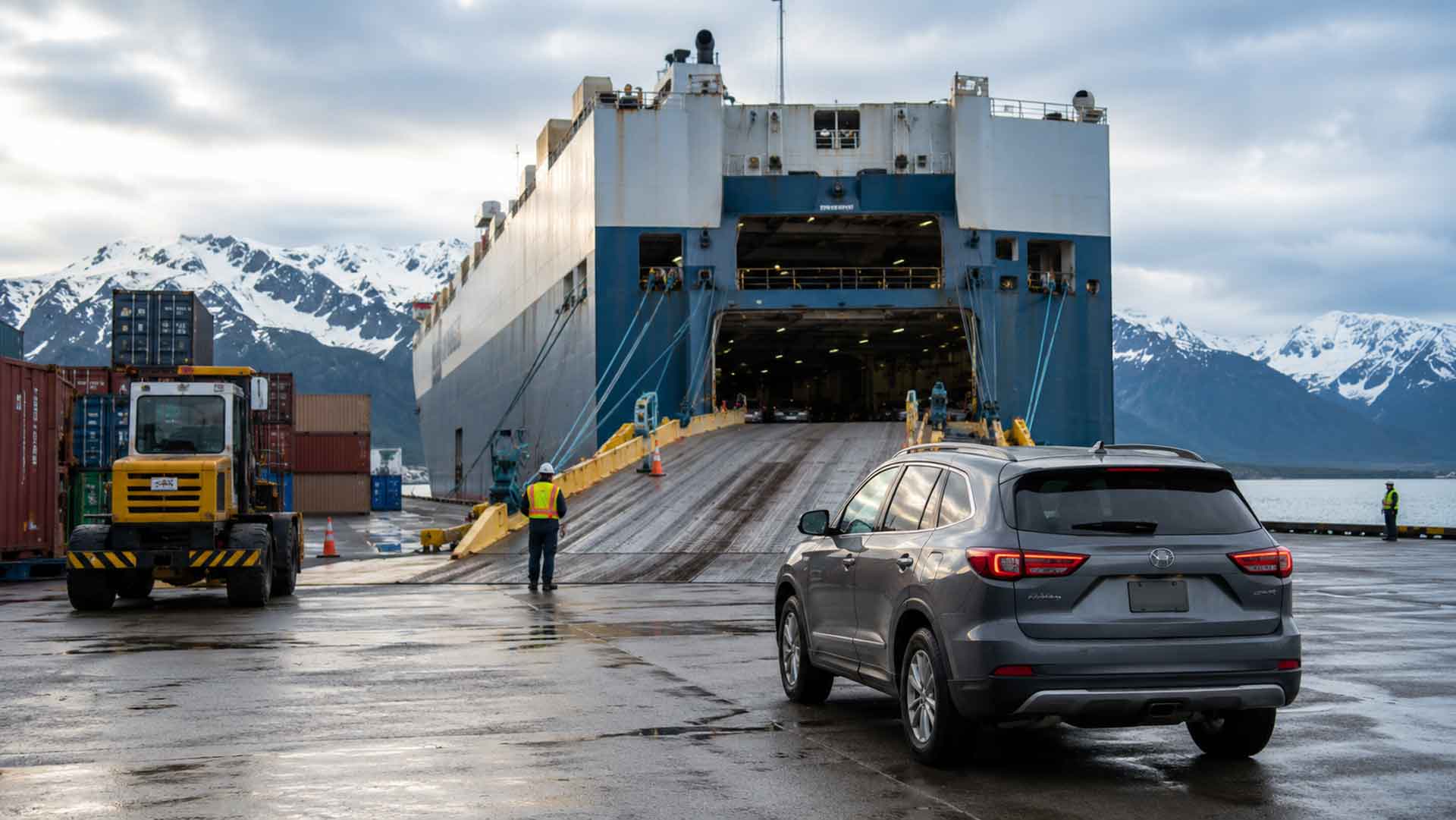
Shipping a Car to Alaska
Shipping a car to Alaska is not one booking. It is a road leg to a West Coast port and an ocean leg on a steamship line, each with its own contract and liability. The expensive surprises happen on the water side, where the ocean carrier sets the terms. This guide covers the routes, published rates, timelines, preparation rules and the vehicles Alaska carriers no longer accept.
Short answer: a car reaches Alaska in two legs, a road haul to a West Coast port and an ocean sailing.
- Most vehicles go Tacoma to Anchorage; Southeast Alaska is served by barge and ferry instead.
- Ocean freight alone starts near $2,500 one way, quoted separately from the road leg.
- The Tacoma to Anchorage sailing runs about three days; door to door is usually two to four weeks.
- The fuel tank must be under a quarter full, and Alaska is one of the few lanes allowing belongings in the car.
- Matson, TOTE Maritime Alaska and Alaska Marine Lines currently refuse electric and plug-in hybrid vehicles.
Contents
- Why Alaska car shipping is a two-leg move
- Which ports and ocean carriers serve Alaska?
- How much does it cost to ship a car to Alaska?
- Can you ship an electric car to Alaska in 2026?
- How long does the whole move take?
- Is it cheaper to drive the Alaska Highway instead?
- How does an Alaska PCS change the process?
- How to prepare your vehicle for the sailing
- What paperwork do you need?
- What happens after your car lands in Alaska
- Mistakes that cost people money
- How the mainland leg works with TCI Logistics
- Frequently asked questions
Why Alaska car shipping is a two-leg move
Alaska has no highway connection to the Lower 48 that avoids Canada, so a vehicle either sails or crosses two international borders. The commercial answer is a two-leg move: a truck carries the vehicle to a West Coast port, and an ocean carrier moves it from that port to Alaska.
Leg one: the road haul to the port
The road leg is ordinary auto transport. An open or enclosed trailer collects the vehicle at your address and delivers it to the port terminal named on your ocean booking. Tacoma is the gateway for Anchorage traffic, Seattle serves the Southeast Alaska barge lines, and pricing follows distance, vehicle size and trailer type.
Leg two: the ocean sailing
The ocean leg is governed by the steamship line, not the trucking company. The line sets the sailing schedule, drop-off window, fuel limit, personal effects policy and storage clock, and issues its own bill of lading. If a rule feels unfamiliar compared with a normal state-to-state move, it comes from the ocean side.
Who is liable for what
Damage on the road leg falls under the motor carrier's cargo coverage. Damage found after the sailing falls to the ocean carrier. The condition report at the port is the boundary between two claims processes, so record the vehicle's condition in writing at drop-off and photograph it in daylight.
Which ports and ocean carriers serve Alaska?
Four operators carry privately owned vehicles between the mainland and Alaska, and they do not serve the same destinations. The wrong choice adds a long, expensive drive on the Alaska side.
| Service | Mainland port | Alaska destinations | Sailing pattern |
|---|---|---|---|
| Matson | Tacoma | Anchorage, Kodiak, Dutch Harbor | Published schedule, 3 to 7 days Tacoma to Alaska |
| TOTE Maritime Alaska | Tacoma | Anchorage | Twice weekly, 3 days in transit |
| Alaska Marine Lines (barge) | Seattle | Southeast and Central Alaska, seasonal Western and Arctic | Scheduled barge sailings |
| Alaska Marine Highway (state ferry) | Bellingham | Southeast Alaska and cross-Gulf ports | Published timetable, seasonal |
Tacoma to Anchorage is the main lane
Anchorage is where most privately owned vehicles land. Matson's Alaska vehicle service lists Anchorage, Kodiak and Dutch Harbor from Tacoma with a transit of three to seven days. TOTE Maritime Alaska runs twice-weekly Tacoma to Anchorage service with a three-day transit.
Southeast Alaska is a different network
Juneau, Ketchikan, Sitka, Petersburg and Wrangell are not served by the Anchorage container ships. Alaska Marine Lines barges vehicles from its Seattle service center to Southeast and Central Alaska. For a Panhandle destination, book the barge, not the Anchorage sailing.
The state ferry as a fallback
The Alaska Marine Highway System is the only one of the four that also carries you. Its published travel policies allow unaccompanied vehicles with a surcharge of $50 to and from Bellingham, $20 to and from Prince Rupert and $10 elsewhere, with loading arranged by the shipper. Check-in is three hours before departure at Bellingham and Whittier.
How much does it cost to ship a car to Alaska?
Budget for two invoices, not one. Ocean freight from Tacoma to Anchorage is published tariff pricing starting in the $2,500 range one way. The road leg is quoted separately.
| Route | Operator | Published ocean rate |
|---|---|---|
| Tacoma to Anchorage | Matson | $2,670.91 to $3,339.01 depending on vehicle height |
| Anchorage to Tacoma | Matson | $2,025.08 to $2,563.49 |
| Tacoma to Anchorage | TOTE Maritime Alaska | $2,541.25 small, $3,175.00 medium, $4,646.25 large |
| Anchorage to Tacoma | TOTE Maritime Alaska | $1,886.50 small and medium |
Matson's figures are the tariff levels effective June 7, 2026 on its vehicle rates page. Ocean tariffs are revised periodically, so confirm the current number before committing to a sailing.
Why height and length change the price
Ocean lines price vehicles by deck space, not weight. Matson applies a maximum envelope of 21 feet 8 inches by 8 feet by 7 feet, tighter on some routes, and its Alaska rates step up with height. A lifted truck, roof box or aftermarket rack can push a booking into a higher band.
What is not in the ocean quote
- the road haul from your address to the port terminal;
- delivery from the Alaska port onward to Fairbanks, Wasilla or the Kenai Peninsula;
- the personal effects fee if you load belongings;
- terminal storage once free time expires;
- fuel drainage charges if the tank is over the limit.
For the road leg, an open auto transport booking is the standard choice, while collectors and owners of high-value vehicles usually pay the premium for enclosed transport. You can price the mainland portion with the TCI shipping cost calculator before you book a sailing.
Can you ship an electric car to Alaska in 2026?
Not on the main commercial lanes. All three primary Alaska ocean carriers have stopped accepting battery electric and plug-in hybrid vehicles, the biggest change in Alaska vehicle shipping in two years. It catches owners out because the road leg is unaffected.
- Matson has suspended new and used electric vehicles and plug-in hybrids across its trades, including Alaska, and says it plans to resume when suitable safety solutions can be implemented.
- TOTE Maritime Alaska no longer accepts electric or plug-in hybrid vehicles effective August 1, 2025, while mild hybrids remain acceptable.
- Alaska Marine Lines states that it does not ship electric or plug-in hybrid electric vehicles.
The stated reason is fire risk from large lithium-ion batteries at sea, following a series of vehicle-carrier fires reported by the maritime press, including the suspension covered by The Maritime Executive.
What electric vehicle owners can still do
The state ferry remains the main scheduled option. Alaska Marine Highway policy allows a maximum of two electric or plug-in hybrid vehicles per vessel per sailing, and damaged or recalled units need transport forms, a technician attestation that the battery is de-energized and visual verification at the terminal. Book that space early and confirm the ocean leg before arranging the truck. Our guide to EV car shipping and port rules covers the wider picture.
How long does the whole move take?
Plan on two to four weeks door to door from most of the Lower 48, and build the estimate from the legs rather than a single headline number.
- Road leg to Tacoma or Seattle. TCI puts coast-to-coast transport at 7 to 10 days and runs under 500 miles at 2 to 3 days once loaded.
- Drop-off window. Matson advises against delivering more than seven days before the booked sailing, since early arrivals risk rejection or storage charges.
- Ocean transit. Three days on TOTE's Tacoma to Anchorage service, three to seven on Matson's Alaska trade.
- Terminal collection. Free time varies by port, and the line notifies you when the vehicle is available.
Season matters more than distance
Late spring through late summer is the busy window for Alaska-bound moves and military rotations, and terminal appointments tighten accordingly. Winter sailings run normally, but weather delays the Alaska-side leg from port to an inland address. With fixed dates, book the sailing first and work backward, using our overview of car shipping delivery timelines for the domestic side.
Is it cheaper to drive the Alaska Highway instead?
Driving is realistic in summer and rarely cheaper once you count fuel, lodging, meals, tires and wear across roughly 2,000 to 2,500 miles of northern highway. It suits people who want the vehicle with them, are moving between May and September and have a week or more to spend.
What the route involves
The Alaska Highway runs from Mile 0 at Dawson Creek, British Columbia, to Delta Junction, Alaska, at historical mile 1422, has been paved since 1992 and stays open year round. The MILEPOST advises planning for 100 to 150 miles between services. Travel Alaska, the state tourism office, recommends a week to 10 days each way.
Documents and the winter tire window
United States citizens crossing into Canada by land need a valid passport, passport card, enhanced driver's license or trusted traveler card, plus vehicle registration and proof of insurance. Travelers under 18 need their own identification. British Columbia requires winter tires or chains on most designated routes from October 1 to April 30, ending March 31 only on selected routes outside mountain passes and high-snowfall areas. That is a seven-month window, not a winter one. Ship instead for an October to April move, when more than one vehicle is going, or when flights and household goods are already booked around a fixed report date.
How does an Alaska PCS change the process?
The commercial route is identical, but the paperwork and who pays are not. Settle the entitlement question before booking commercially, because a government-funded shipment moves through a different channel than a retail booking.
What is covered and what is not
Military OneSource states that for moves outside the continental United States, only one privately owned vehicle owned or leased for personal use may be shipped at government expense. Whether a specific Alaska move qualifies, and what applies to a CONUS-to-CONUS relocation, depends on your orders and the Joint Travel Regulations, so confirm it with your transportation office rather than a transport company.
The Vehicle Processing Center route
Government-funded shipments run through the Department of Defense network of Vehicle Processing Centers, so drop-off, documentation and collection follow that contract rather than a steamship line's retail rules. If you are paying yourself, or shipping a second vehicle, the commercial Tacoma route in this guide applies as normal. Our guide to POV entitlements, storage and timelines covers who pays for what, and the military PCS vehicle shipping guide covers the wider sequence.
How to prepare your vehicle for the sailing
Ocean preparation rules are stricter than domestic ones because a vessel is a confined space. Fuel is the rule that stops the most vehicles at the gate.
Keep the tank under a quarter
Matson and Alaska Marine Lines both require less than a quarter tank of fuel, citing United States Coast Guard rules that treat gasoline as a hazardous material, and Alaska Marine Lines charges a drainage fee if the tank is over. That is stricter than the domestic standard, where TCI's terms allow half a tank, so burn the difference off before the port run.
The Alaska personal effects exception
Alaska is one of the few lanes where belongings inside the vehicle are permitted. Matson allows personal effects up to 3,000 pounds on Tacoma and Alaska routes for a flat fee stated at $200, provided visibility through all windows stays clear and the cargo remains accessible for inspection. TOTE lists a flat charge of $181. Alaska Marine Lines permits items but not in the front seat, behind the driver's seat or on roof racks other than enclosed carriers, and values cargo at $0.10 per pound. Compare the domestic rules in our guide to shipping a car with personal items.
Cleaning and condition
Matson asks owners to wash the exterior and vacuum the interior before drop-off, with the interior completely dry and no shampooing beforehand. Existing windshield chips or cracks need individual approval, with photographs sent to customer service in advance. A clean vehicle also produces a usable condition report, which is what a claim depends on. Our checklist for preparing a car for shipping applies to the road leg too.
Non-running vehicles
Inoperable vehicles move on both legs but must be declared in advance on each. Alaska Marine Lines accepts inoperable gasoline vehicles with additional loading fees, and on the road side a winch or forklift load is arranged through inoperable car transport. An undeclared non-runner is the classic cause of a refused pickup and a re-quote at the curb.
What paperwork do you need?
Ocean carriers run on the booking number. Bring it, bring photo identification and bring the documents proving you are entitled to ship the vehicle.
- At drop-off: booking confirmation, vehicle registration, keys and title documentation where the route requires it.
- At collection: the booking number and photo identification, both required by Matson.
- If someone else collects: Matson requires the shipper to email an image of their driver's license, the booking number and the collector's name beforehand.
- If the vehicle is financed: expect a lienholder authorization. Alaska Marine Lines lists a lien holder affidavit where applicable.
- If the title is in transit: resolve it first. Our walkthrough on transferring a car title covers the sequence.
What happens after your car lands in Alaska
Two clocks start when the vessel docks: terminal storage and Alaska registration. Both cost money if ignored.
Free time and storage
Ocean lines allow limited free time at the destination terminal, after which daily storage charges apply, and the period varies by port. Collect as soon as the availability notice arrives, or arrange authorized third-party collection if you are still traveling.
The 10-day registration rule
The Alaska Division of Motor Vehicles requires new residents to register a vehicle within 10 days of entering the state or taking a job there. The driver license deadline is 90 days, or 30 for commercial licenses, and visitors may drive an out-of-state registered vehicle for up to 60 days. The vehicle deadline is the tight one.
Military exemption
Active duty service members stationed in Alaska may keep a valid, unexpired home-state registration, and members and spouses are exempt from the license transfer requirement. Confirm the current position with the Alaska DMV new resident guidance before paying for a registration you do not need yet.
Mistakes that cost people money
- Booking the truck before the sailing. Reverse that order and you pay storage or miss the vessel.
- Assuming an electric vehicle will be accepted. Get the carrier's policy in writing first.
- Arriving with a full tank. Under a quarter is a Coast Guard-driven rule, and drainage is chargeable.
- Dropping off too early. More than seven days ahead of a Matson sailing risks refusal or storage.
- Ignoring vehicle height. Alaska rates step up by height, and a roof rack can change the band.
- Forgetting the Alaska-side leg. Anchorage to Fairbanks is roughly 360 road miles.
- Booking the wrong network for Southeast Alaska. Juneau and Ketchikan are barge and ferry destinations.
How the mainland leg works with TCI Logistics
TCI Logistics handles the road portion of Alaska moves and delivers to the Port of Seattle-Tacoma. Drivers on port runs hold the Transportation Worker Identification Credential required for secure maritime facilities, and vehicles must arrive running, free of oil leaks and under a quarter tank. Details are on the port-to-port vehicle transport page and the auto transport services page. For international moves, see our guide to shipping a car overseas.
Frequently asked questions
Can I put belongings in my car when shipping it to Alaska?
Yes, and Alaska is unusual in this. Matson permits personal effects up to 3,000 pounds on Tacoma and Alaska routes for a flat fee stated at $200, provided visibility through all windows stays clear. TOTE lists a flat $181 charge. Alaska Marine Lines allows items with placement restrictions and values them at $0.10 per pound.
Why won't anyone ship my Tesla or plug-in hybrid to Alaska?
Because the ocean carriers stopped accepting them. Matson suspended battery electric and plug-in hybrid vehicles across its trades, TOTE Maritime Alaska stopped from August 1, 2025, and Alaska Marine Lines does not carry them. Fire risk from large lithium-ion batteries at sea is the stated reason. The state ferry currently allows two such vehicles per vessel per sailing.
How much does it cost to ship a car from Seattle to Anchorage?
Ocean freight alone is published tariff pricing. Matson lists Tacoma to Anchorage from $2,670.91 to $3,339.01 by vehicle height, and TOTE lists $2,541.25 small, $3,175.00 medium and $4,646.25 large. Add the road haul to the port and delivery from the Alaska port to your address.
How long does a car take to reach Anchorage from the East Coast?
Two to four weeks is a realistic planning range. Add the road leg, which TCI estimates at 7 to 10 days coast to coast, the drop-off window at the port, and the sailing, which is three days on the twice-weekly TOTE service and three to seven days on Matson's Alaska trade. Terminal collection adds a day or two.
How quickly do I have to register the car once it arrives in Alaska?
New residents must register a vehicle within 10 days of entering the state or taking a job in Alaska. The driver license transfer deadline is longer at 90 days, or 30 days for commercial licenses. Active duty service members stationed in Alaska may keep a valid, unexpired home-state registration instead.