
 (312) 224-8620
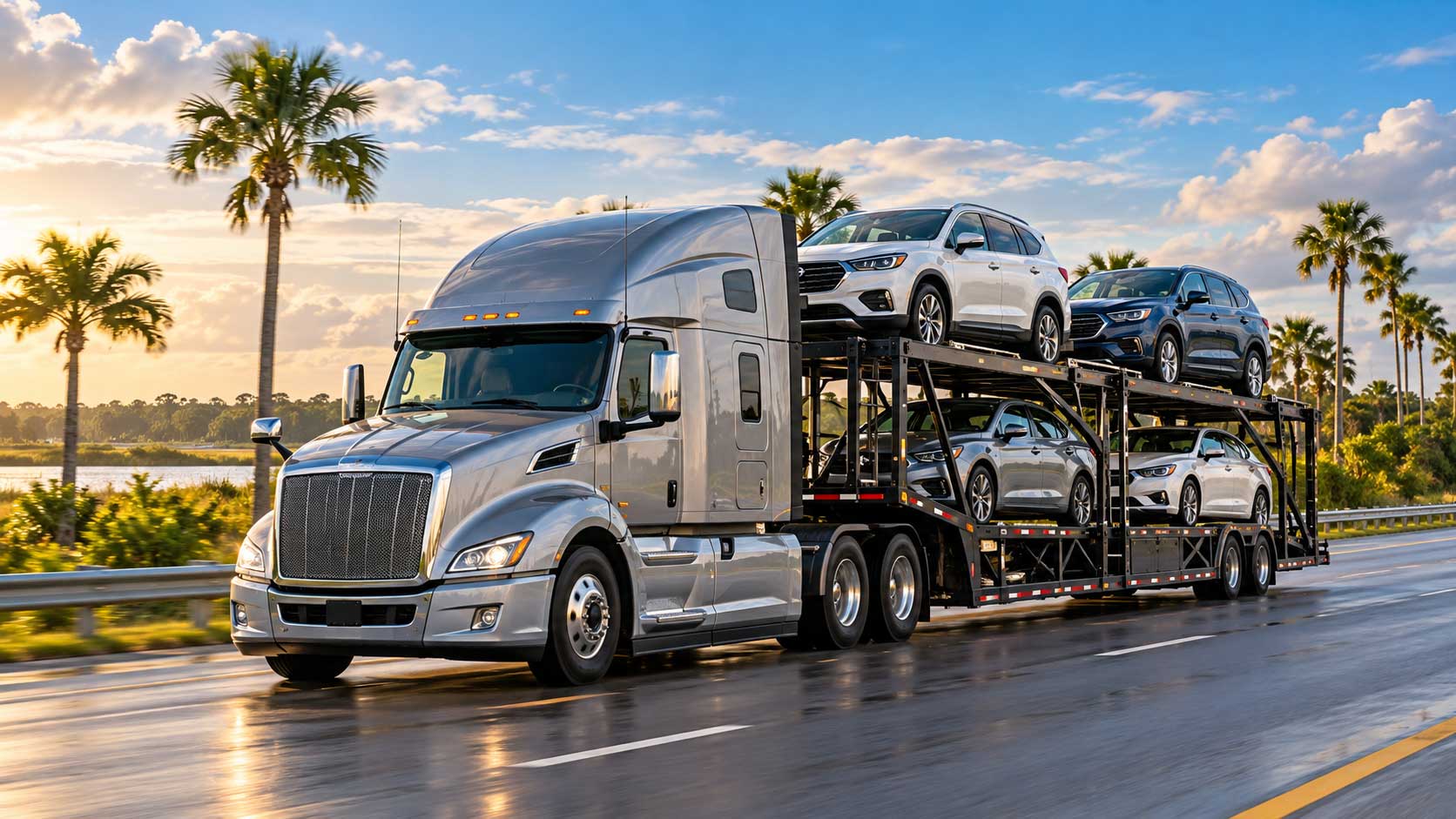
Shipping a Car to Florida
Shipping a car to Florida from the Northeast or the Midwest usually takes 3 to 7 days on the truck, after a pickup window of 1 to 4 business days. Seasonal demand can change both the price and pickup availability, especially on southbound routes in the fall. Once you settle, Florida's registration deadline is tied to starting a job or enrolling children in school, not to the day the car is delivered.
In short
- A Northeast or Midwest origin usually means 3 to 7 days in transit, and a metro pickup is far easier to schedule than a rural one.
- Southbound demand peaks in the fall with the snowbird migration, and the hurricane season runs until November 30; TCI's terms exclude weather damage on the carrier's side.
- Florida law requires registration within 10 days of starting work in the state or enrolling children in a public school, and the car needs Florida PIP and property damage coverage first.
- A car brought in within six months of purchase owes Florida's 6% use tax unless it was used in another state for six months or more, with credit for tax already paid elsewhere.
Contents
- How long shipping a car to Florida takes
- Season decides the price and the pickup date
- Delivery addresses and the route into Florida
- Registering the car: the 10-day rule
- VIN verification, title and the $225 fee
- Use tax on a car bought before the move
- At pickup and at delivery
- Frequently asked questions
How long shipping a car to Florida takes
Transit time follows distance once the car is loaded, and TCI publishes four distance bands for it. The pickup window comes first: TCI's terms ask for 1 to 4 business days.
| Distance band | Transit once loaded | Example city pairs |
|---|---|---|
| Under 500 miles | 1 to 3 days | Atlanta to Orlando, Charleston to Orlando |
| 500 to 1,500 miles | 3 to 5 days | New York to Miami, Chicago to Orlando, Detroit to Tampa, Dallas to Orlando |
| 1,500 to 2,500 miles | 5 to 7 days | Minneapolis to Tampa, Denver to Orlando, Phoenix to Miami |
| Over 2,500 miles | 7 to 10 days | Los Angeles to Miami, Seattle to Orlando |
The bands come from the guide to car shipping delivery timelines. TCI's FAQ separately gives 5 to 7 days for north to south moves, so 3 to 7 days is the honest planning range from the Northeast or Midwest. Weather, breakdowns and storm closures can extend any of these.
Pickup is where the days are won or lost
TCI's FAQ notes that a pickup in a large metro area usually happens on the requested date, while a rural pickup can take 2 or 3 days to arrange. The same FAQ recommends ordering at least one week ahead. For a fall move south, an enclosed trailer or a pickup outside a metro area, book earlier than that.
Season decides the price and the pickup date
Florida lanes are strongly seasonal. TCI's FAQ states that shipping a car down to Florida in the fall costs more because of the volume of snowbird traffic heading south, and its state-to-state guide describes the northbound spring wave the same way.
Moving with or against the snowbird wave
A relocation timed against the wave, south in late spring or north in the fall, is less exposed to the seasonal rate spike. A move that has to happen in October or November southbound should be booked early and priced with a flexible pickup date. Exact dates for seasonal residents are in the guide to snowbird car shipping.
Hurricane season and who carries the risk
NOAA dates the Atlantic hurricane season from June 1 to November 30. A storm can close roads and stop pickups and deliveries in the affected area for days. TCI's terms state that damage caused by weather, including hurricanes, floods and wind, is not covered by the carrier, and that natural disasters can delay pickup or delivery.
Two practical consequences follow. Check whether your own auto policy covers the car while it is on a carrier, and keep the delivery date flexible for a coastal address between August and October. The guide to storm season car shipping covers rerouting and revised ETAs.
Open or enclosed
Trailer type is the other price lever. Most daily drivers go on an open car carrier. TCI's FAQ puts enclosed transport at about $300 to $400 more, notes that damage from acts of nature and road debris is not covered, and offers enclosed transport to owners worried about it. That is why a classic or a high-value car heading south in storm season is the usual case for enclosed auto transport.
Distance, vehicle size, whether the car runs, trailer type and season set the rest of the price, and TCI adds $200 for an inoperable vehicle. A quote for your ZIP codes and date comes from the TCI car shipping calculator.
Delivery addresses and the route into Florida
Door-to-door delivery works for most Florida addresses, but not all of them can take a full-size carrier. TCI's FAQ notes that many trucks are over 75 feet long, and when a street, gate or access rule keeps the truck out, the driver meets you at the nearest safe location.
Addresses to flag at booking
- gated communities and condominium buildings that restrict large vehicles;
- narrow residential streets and cul-de-sacs;
- barrier islands and the Keys, where access and distance add time;
- rural inland addresses away from I-95 and I-75.
Mention these when you book, not on delivery day, so the meeting point is agreed in advance. When no nearby meeting point works, a terminal is the fallback, explained in the guide to door-to-door and terminal shipping.
Which interstate the truck takes
Cars from New England, New York and the Mid-Atlantic arrive on I-95 toward Jacksonville, the Space Coast and South Florida. Cars from Michigan, Ohio and the Tennessee and Georgia corridor come down I-75 toward Tampa, Sarasota, Fort Myers and Naples. Cars from Texas and the Gulf states enter on I-10 at Pensacola. Orlando is reached from either main corridor by I-4 or Florida's Turnpike.
For the reverse coast-to-coast move, the California side is covered in the guide to shipping a car to and from California.
Registering the car: the 10-day rule
Florida requires a car to be registered within 10 days after its owner starts work in Florida or enrolls children in a Florida public school. The rule is in Florida Statutes section 320.38, which ends the out-of-state registration privilege once either happens. The clock is set by those events, not by the delivery date of the car.
Other residency triggers
Registering to vote, filing for a homestead exemption or living in Florida for more than six consecutive months also establish residency. FLHSMV lists them in its new resident guidance, which tells new residents to obtain Florida insurance within 10 days of establishing residency and to get a Florida driver license within 30 days.
Florida insurance comes before registration
Florida will not register a car without Florida coverage. FLHSMV requires at least $10,000 of personal injury protection and $10,000 of property damage liability, in force at registration and issued by an insurer licensed in Florida. If you start a job the week you arrive, arrange the Florida policy before the move, because the 10 days may already be running when the car is delivered. The minimums are on the FLHSMV insurance requirements page.
Exemptions
Section 320.38 exempts migrant and seasonal farm workers and certain nonresident college students whose vehicles are properly registered elsewhere. A seasonal resident who neither works in Florida nor enrolls children in school is not caught by the 10-day rule on that basis, but more than six consecutive months in the state establishes residency.
VIN verification, title and the $225 fee
A car titled in another state needs a VIN and odometer verification before Florida will title it. It is recorded on form HSMV 82042, or in the VIN section of the title application, HSMV 82040.
Who can verify the VIN
FLHSMV lists a law enforcement officer, a military police officer, a licensed Florida dealer, a county tax collector employee or a Division of Motorist Services compliance examiner. The Pinellas County Tax Collector also accepts the form completed by a notary, or the car brought to the office. Either way, the person verifying needs to see the car, so book it after delivery.
When the $225 initial registration fee applies
The fee is charged when the owner has no Florida license plate, or record of one, registered in their name from a previously owned vehicle that could be transferred to this one. For most people arriving from another state, that means it applies. FLHSMV sets out the condition on its motor vehicle registration page. Title fees, $77.25 for an original new title and $85.25 for an original used title, are on the FLHSMV fee schedule.
Title held by a lender
If a lienholder holds the out-of-state title, FLHSMV tells the owner to ask the lienholder to transfer it to Florida, and a letter on the lender's letterhead lets you register the car if the lender refuses. The general steps for moving a title between states are in the guide to transferring a car title.
Use tax on a car bought before the move
Florida's 6% use tax applies to a motor vehicle brought into the state within six months of purchase. The Department of Revenue's tax information for new residents also states the main exception: a vehicle used in another state for six months or longer before entering Florida is presumed not to have been bought for use in Florida, provided you can document that use.
Credit for tax paid elsewhere
If you paid a similar tax of 6% or more in another state, no Florida use tax is due; if you paid less, you pay the difference. A car bought in a state with no sales tax and brought in within six months owes the full 6%.
The county surtax and its $5,000 cap
On top of the state rate, the discretionary sales surtax of the county where you live may apply. It is charged only on the first $5,000 of the purchase price, under the Department of Revenue's guide to sales and use tax on motor vehicles, and its worked example shows the surtax still applying after a credit for tax paid in another state.
Keep the purchase contract, the out-of-state registration and anything that shows where the car was used before the move. Buyers shipping a car home after an online purchase face the same rule, covered in the guide to shipping a car after buying online.
At pickup and at delivery
The handover is short. TCI's FAQ states that only the keys are needed at pickup, not the title or insurance documents, and the condition of the car is recorded on the bill of lading.
- keep fuel at half a tank or less, the limit in TCI's terms;
- remove belongings, which travel at the owner's risk, and avoid weighing the car down;
- photograph the car in daylight before loading;
- at delivery, check the car before signing and write any new damage on the bill of lading while the driver is still there.
What can and cannot stay in the car is explained in the guide to shipping a car with personal items. For a fixed-date move, the TCI contact page lists the phone line and email.
Frequently asked questions
How long do I have to register my car after moving to Florida?
Ten days from starting work in Florida or enrolling children in a public school, under Florida Statutes section 320.38. The car must have Florida PIP and property damage coverage before it can be registered, so arrange that policy early.
Do I pay Florida tax on a car I bring from another state?
Only if it enters Florida within six months of purchase and was not used in another state for six months or more. Then the 6% use tax applies, minus similar tax already paid elsewhere, plus any county surtax on the first $5,000.
How long does it take to ship a car from New York to Florida?
Usually 3 to 7 days once the car is on the truck, after a pickup window of 1 to 4 business days. Fall demand and storms in hurricane season can extend that.


