
 (312) 224-8620
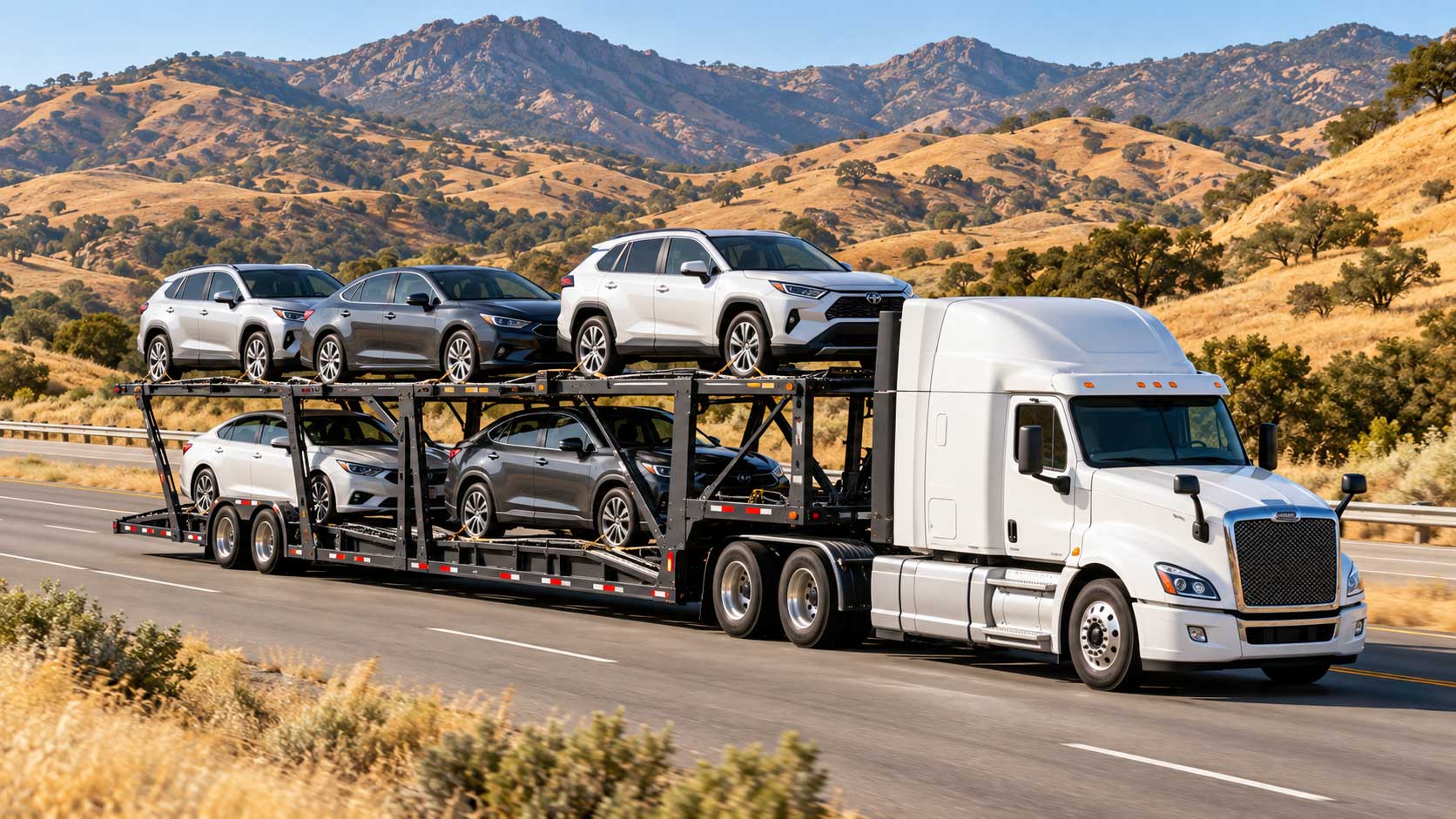
Shipping a Car to California
Shipping a car to California is an ordinary state-to-state booking on the road: a carrier collects the car, rides one of the main interstate corridors and delivers it door to door in about 1 to 10 days of transit, depending on distance. The part that catches people out comes after delivery. California runs its own registration clock, requires a smog check on first registration for almost every gasoline car, new or old, and restricts nearly new cars that were not built to California emission standards.
In short
- A coast-to-coast run to California usually takes 7 to 10 days once the car is loaded, after a pickup window of 1 to 4 business days.
- California expects the registration application within 20 days of the date fees become due, which for most movers is when residency starts.
- A car being registered in California for the first time needs a smog check, and the newer-vehicle exemptions do not cover that first registration.
- A nearly new car without California emission certification, bought by a California resident with fewer than 7,500 miles, can be refused registration; a car acquired while you lived in another state qualifies for an exemption.
Contents
- What is different about shipping a car to California
- The main routes into California and what slows them
- How long shipping a car to California takes
- What drives the price on California lanes
- The 20-day registration clock
- Smog check and the 7,500-mile rule
- Use tax on cars bought outside California
- From delivery to the DMV: the order that saves a trip
- Shipping a car out of California
- Frequently asked questions
What is different about shipping a car to California
The transport itself works like any long-distance booking. California differs in two ways: the volume of cars moving in and out of its metro areas, which affects how quickly a carrier is assigned, and the paperwork the state requires once the car arrives.
Carrier supply is uneven across the state
Greater Los Angeles, San Diego, the Inland Empire and the San Francisco Bay Area sit on the main interstates and see constant carrier traffic. Addresses in the far north, the mountains or small Central Valley towns pull a driver off the corridor. TCI's FAQ notes that a metro pickup usually happens on the requested date, while a rural pickup can take 2 or 3 days to arrange.
The state checks the car after it arrives
In many states, registering an incoming car comes down to the title, proof of insurance and sometimes a VIN check. California adds an emissions inspection, a mileage and certification test for nearly new cars and a use tax check on recent out-of-state purchases. None of this affects the truck. All of it affects what you do in the weeks after you arrive.
The main routes into California and what slows them
Most cars shipped to California arrive on one of five long-haul interstates, and the route is set by where the car starts. Knowing the corridor tells you which mountain pass can hold the truck in winter.
| Interstate | Typical origins | Arrives in | Pass to watch in winter |
|---|---|---|---|
| I-10 | Florida, the Gulf Coast, Texas, southern Arizona | Inland Empire, Los Angeles | No Sierra or Grapevine crossing |
| I-40 | The Carolinas, Tennessee, Arkansas, Oklahoma, northern Arizona | Barstow, then Southern California | Flagstaff area in northern Arizona |
| I-15 | Utah, Las Vegas, the Mountain West | Inland Empire, San Diego | Cajon Pass into the Inland Empire |
| I-80 | The Northeast, Chicago, the Midwest, Nevada | Sacramento, Bay Area | Donner Summit in the Sierra Nevada |
| I-5 | Washington, Oregon | Sacramento, Bay Area, then south | Siskiyou Summit, then the Grapevine for Los Angeles |
For a firm delivery date between November and April, the I-80 and I-5 crossings are where most of the winter schedule risk sits.
The Grapevine
Interstate 5 over the Tejon Pass, known as the Grapevine, links the Central Valley and Northern California with Los Angeles on a 6 percent grade for five miles. Caltrans' Operation Snowflake guidance states that full closures happen an average of three to five times between October and April, typically for four to six hours and sometimes more than a day, and that chains are not permitted on the Grapevine. A truck caught on the wrong side waits for the reopening or takes a long detour.
Donner Summit on I-80
Cars from the Midwest and Northeast often reach Northern California over the Sierra Nevada on I-80. Winter storms bring chain controls for trucks and, at times, full closures between the Nevada line and the Sacramento foothills. Live status is on the Caltrans QuickMap, and it is the reason an estimated delivery date in January is a range rather than a promise.
How long shipping a car to California takes
Transit time is set by distance once the car is on the truck, and TCI publishes four bands. Add the pickup window, which TCI's terms put at 1 to 4 business days, before the transit clock starts.
| Distance | Transit once loaded | Example origins for Los Angeles |
|---|---|---|
| Under 500 miles | 1 to 3 days | Las Vegas, Phoenix |
| 500 to 1,500 miles | 3 to 5 days | Salt Lake City, Denver, Seattle, Dallas |
| 1,500 to 2,500 miles | 5 to 7 days | Chicago, Atlanta, Minneapolis |
| Over 2,500 miles | 7 to 10 days | New York, Boston, Miami |
These bands come from the guide to car shipping delivery timelines and match the 7 to 10 days TCI's FAQ gives for coast-to-coast moves. They are estimates rather than commitments: weather, mechanical problems and closures on the passes above can extend them.
How far ahead to book
TCI's FAQ recommends placing the order at least one week before the desired pickup date. Allow more for enclosed transport, a rural address or a move timed to the start of a job, a school term or a lease, when a late car means renting one.
What drives the price on California lanes
The price of shipping a car to California is set by the same few factors as any route, weighted by how busy the specific lane is. TCI's FAQ lists route distance, vehicle size, whether the car runs, trailer type and season.
- Distance and corridor: long interstate runs cost less per mile than short ones, and lanes between major metros refill trucks quickly.
- Exact pickup and delivery points: an address off the interstate costs more than a metro address on the same route.
- Vehicle size and condition: a full-size truck takes more deck space than a sedan, and TCI adds a $200 fee for an inoperable vehicle.
- Trailer type: enclosed transport costs more than open; TCI's FAQ puts the difference at about $300 to $400.
- Season and direction: demand rises in summer and around the snowbird migrations, and one direction of a lane can price differently from the other.
Most cars go on an open car carrier, the standard option for a daily driver. A classic, an exotic or a car with low ground clearance usually justifies enclosed auto transport.
A quote for your exact ZIP codes, vehicle and date comes from the TCI car shipping calculator. The full set of variables, including why the same lane quotes differently from week to week, is in the breakdown of what affects car shipping cost.
The 20-day registration clock
California requires the application for registration within 20 days of the date registration fees become due, under Vehicle Code section 4152.5, and late filing carries penalties. For a car you already own, fees generally become due when you establish California residency.
What counts as residency
Taking a job in California or being issued a California driver license are among the indicators that establish residency. They are listed in the DMV's guidance on determining residency for out-of-state vehicles, which also notes that military personnel are not considered gainfully employed in California. The DMV advises submitting the application and fees on time even if the title or smog certificate is still missing, to avoid penalties.
What the DMV asks for
- Application for Title or Registration, form REG 343, signed by all registered owners;
- the last out-of-state title, or the registration will be marked nontransferable;
- the last out-of-state registration;
- Verification of Vehicle, form REG 31, completed by a DMV employee, a law enforcement officer or a California-licensed vehicle verifier;
- a smog certification where the vehicle type requires one;
- payment of registration, transfer and use tax fees.
The list follows the DMV's instructions for registering a vehicle from out of state, and the DMV's online fee calculator estimates the amount before the visit. Since the VIN verification needs the car present, schedule the DMV appointment for after the delivery date, not before.
Active duty military
Nonresident active duty members and their nonresident spouses may keep renewing the car's registration in their home state instead of registering in California. Those who do register in California can file a Nonresident Military Exemption Statement, form REG 5045, for exemption from the vehicle license fee portion of the registration fees.
Smog check and the 7,500-mile rule
A smog check is required to register a vehicle in California for the first time, including one purchased or previously registered in another state. The rule is set out by the Bureau of Automotive Repair, and the DMV's out-of-state checklist lists smog certification for gasoline vehicles from 1976 and newer with no newer-car exception.
Which cars are exempt
- gasoline, hybrid and alternative-fuel vehicles from model year 1975 and older;
- diesel vehicles from model year 1997 and older, or with a gross vehicle weight rating above 14,000 pounds;
- electric vehicles;
- motorcycles.
BAR lists its newer-vehicle exemptions, eight model years for renewal and four model years for change of ownership, against those two transactions only. A late-model gasoline car arriving from another state should be expected to need the inspection. The check also confirms that aftermarket parts meet California rules, so a modified intake or exhaust that was legal in the previous state may fail here.
Cars not certified for California
A car built only to federal emission standards, which the DMV calls a California noncertified vehicle, cannot be registered to a California resident who bought it with fewer than 7,500 miles unless an exemption applies. Exemptions are claimed on form REG 256F, which the DMV's nonresident vehicle page points to.
The exemptions that matter to movers
- You acquired the car while you were a resident of, or on active military duty in, another state, which you certify on REG 256F with the state where it was last registered.
- You inherited the car or were awarded it in a divorce, dissolution or legal separation.
- You bought it out of state to replace a car registered in your name that was damaged, inoperative or stolen out of state, under the conditions on the form.
For someone relocating with a car bought while living elsewhere, the rule is usually a form to sign, not a refusal. The real risk is a California resident buying a nearly new, federal-only car in another state and shipping it home. Check the emissions label under the hood for California or 50-state certification before paying, and see the guide to buying a car from another state for the transaction side.
Use tax on cars bought outside California
Use tax can apply when a car bought outside California is brought into the state within 12 months of purchase, but timing alone does not decide it. The California Department of Tax and Fee Administration states that the tax is normally paid at DMV registration, with a credit for sales tax already paid to another state.
The 12-month presumption
A vehicle bought outside California, first used outside the state and brought in within 12 months of purchase is presumed to have been bought for use in California when any one of these applies:
- the buyer is a California resident;
- the vehicle is subject to California DMV registration during the first 12 months of ownership;
- a nonresident buyer uses or stores it in California more than half the time during the first 12 months.
The second condition is the one that catches movers, because a new resident must register the car. The presumption can be rebutted with documents showing the car was bought for use elsewhere, such as the purchase contract, insurance records and out-of-state registration, as set out in CDTFA's 12-month test.
Common situations
- Owned for years before the move: outside the 12-month window, so the presumption does not arise.
- Bought shortly before moving: inside the window; sales tax paid in the other state is credited against the California amount.
- Gift: CDTFA states use tax is not owed on a vehicle received as a genuine gift, from anyone, when nothing is given in return; a signed statement from the former owner and the title support the claim.
- Purchase from a qualifying family member: not taxed when the seller is a parent, grandparent, child, grandchild, spouse or registered domestic partner, or a sibling if both were minors at the sale, and the seller is not in the business of selling vehicles. Stepparents and stepchildren generally do not qualify.
- Active duty member on orders: may not owe use tax if the car was bought and delivered outside California before the orders were received.
Buyers bringing a car home from an online sale or an auction face the use tax question at registration, as covered in the guide to shipping a car after buying online.
From delivery to the DMV: the order that saves a trip
The VIN verification needs the car in California, but the 20-day clock does not wait for it. Use this order, and file on time even if a document is still missing.
- Inspect the car on delivery and write any new damage on the bill of lading before the driver leaves.
- Get the smog check at a California smog station if the car is not exempt, so the certification is on file when you apply.
- Arrange the VIN verification on form REG 31 with the car present, at the DMV or through a California-licensed verifier.
- File REG 343 with the out-of-state title and registration and pay the fees, including any use tax, inside the 20 days. The DMV advises submitting the application and fees on time even if the title or smog certificate is still missing, to avoid penalties, so do not hold the filing back for steps 2 and 3.
Before the truck arrives
The pickup itself is simple. TCI's FAQ states that only the keys are needed, not the title or insurance documents, and its terms allow no more than half a tank of fuel. Leave fruit, plants and soil out of the car: the California Department of Food and Agriculture runs 16 border protection stations on the highways into the state that check vehicles and commodities for invasive pests.
If the delivery street cannot take a full-size carrier, the driver meets you at the nearest safe location, and the guide to door-to-door and terminal shipping explains when a terminal makes sense. Belongings left in the car travel at the owner's risk, as covered in the guide to shipping a car with personal items.
Shipping a car out of California
Shipping a car out of California follows the same booking process, and pickups in the Los Angeles, San Diego and Bay Area metros are among the easiest to schedule. The paperwork moves to the destination state, which sets its own registration deadline.
Paperwork that follows the car
CDTFA notes that a California owner moving away may be asked by the new state to show verification of the tax paid to California, so keep the purchase and DMV records with the title. The steps for retitling in the new state are in the guide to transferring a car title. Route-level notes for the most common destinations are in the overview of state-to-state car shipping routes.
For a move from California to Florida, which runs mostly on I-10, the Florida side of the move, including its 10-day registration rule, is covered in the guide to shipping a car to Florida.
Through a California port
A vehicle imported through the Port of Los Angeles or Long Beach needs customs clearance before any truck can collect it. The forms, duties and age rules are explained in the guide to importing a car to the USA. For a port pickup quote, the TCI contact page lists the phone line and email.
Frequently asked questions
Do I need a smog check to register an out-of-state car in California?
Usually, yes. The Bureau of Automotive Repair requires a smog check when a vehicle is registered in California for the first time. Gasoline cars from 1975 and older, diesels from 1997 and older or over 14,000 pounds GVWR, electric vehicles and motorcycles are exempt.
How long does it take to ship a car to California from the East Coast?
About 7 to 10 days once the car is on the truck, after a pickup window of 1 to 4 business days. Winter storms on I-80 or a Grapevine closure on I-5 can delay delivery.
Do I have to pay California tax on a car I bought in another state?
If it enters California within 12 months of purchase and you are a resident or must register it here in that first year, use tax is presumed and is normally paid at DMV registration. Sales tax already paid elsewhere is credited, and gifts and purchases from qualifying family members are not taxed.


